
AI eating software company?
Constellation software (CSU) is trying to give us a clue

Back in August 2011, Marc Andreessen famously wrote “Why Software Is Eating the World.” Fast forward to 2025, and the fate of software doesn’t feel quite as certain. AI has introduced a new kind of existential question:
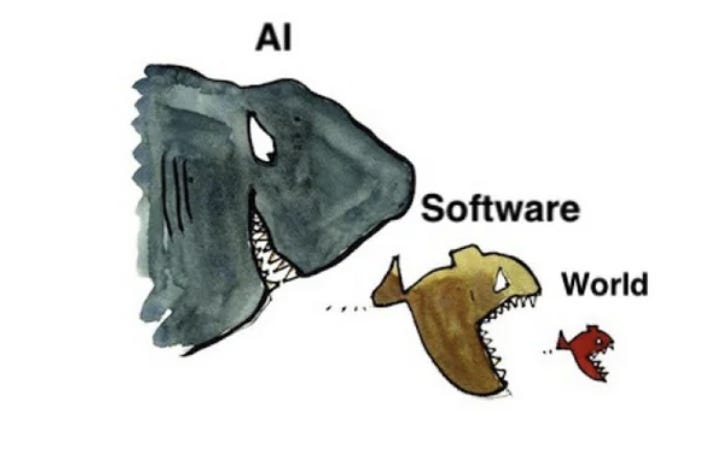
Sources: Software is eating the world.. AI is eating software
Will AI eat software for breakfast?
Plenty of software giants are already at a crossroads. Adobe? Checked. Salesforce? Checked. Atlassian? Checked. Even the mightiest of them all, Constellation Software (CSU) , is down 20% from its all-time high!
And that’s telling.
For years, CSU was one of the cleanest thesis in investing: acquire niche Vertical Market Software (VMS) companies with sticky customers, high switching costs, and predictable cash flows. Most importantly, don’t overpay and be discipline on the investment hurdle.
But 2025 feels different. For the first time, management openly acknowledged that AI might challenge their moat and admitted they don’t yet know how it will turn out.
Unlike most companies, CSU didn’t dodge the issue. They invited real AI experts (albeit, it is their internal staffs) to their annual conference and openly debated the risks. No avoiding. No sugarcoating. Just plain honesty. That level of transparency is rare, and in my view, a big reason CSU still stands apart.
Here are my main takeaways from the conference:
1. Customers May Erode the Moat Themselves
CSU’s edge has always been that building specialized software was too complex and expensive for individual customers.
AI threatens to flip that logic.
Mark Leonard described the “natural tension”: AI helps CSU deliver more customization, but it also empowers clients to try building their own solutions in-house.
As one panelist noted, it’s now easier for a new CTO to ask: “Why don’t we just give this a go ourselves?”
That said, AI is still at an early stage. Debugging remains unreliable, and while AI makes it cheap to spin up software quickly, the real cost often lies in maintaining those systems over time. The caveat is that AI is improving at a very high pace, so today’s shortcomings may not last long.
If AI enables customers to build “good enough” tools, switching costs could erode. But whether those tools can scale and endure as robustly as CSU’s solutions is still an open question.
2. The “AI Tax” on Margins
CSU thrives on high gross margins. Build software once, add customers at nearly zero cost.
AI changes that equation.
Every AI integration introduces token costs, anywhere from $1–$8 per user/month today. Small in isolation, but the deeper concern is dependency.
If CSU relies too heavily on a single AI provider, that provider could raise prices and capture the economics, becoming a toll booth on CSU’s revenue stream.
Management sees the risk. One unit is already developing a “Switzerland-type” platform to avoid vendor lock-in. Besides, they also think that they can pass down the cost to their customers as an add on features to avoid margin erosion.
3. Productivity Gains Are Underwhelming (So Far)
The bull case is simple: AI won’t just disrupt CSU; CSU will use AI to get even more efficient.
But results so far? Underwhelming.
After a year of using AI coding tools, one large unit’s programming efficiency was “almost entirely flat.” Customer support bots diverted only 10–20% of calls, far below expectations.
If AI-native startups achieve real productivity gains while CSU lags, incumbency could flip into liability.
4. Management Admits They Don’t Know
Perhaps the most striking moment was Leonard’s candor:
“It’s difficult to say whether programming is facing a renaissance or a recession.”
He reminded investors of how the father of AI, once misforecasted the future of radiologist, a warning that even the experts get disruption wrong and this just further prove that forcasting is notoriously hard.
Leonard thinks that we should be a blend of anthropologist + scientist:
“It’s really important to dig in and try and understand, to be an anthropologist, to observe and test the claims that you hear and try to understand current state of the art. … The other way is to be a scientist—actually run experiments, try AI against the alternatives, and see if you get significant improvements in whatever it is you’re endeavoring to do.”
Cautious. Curious. Evidence-based. That mindset may be CSU’s greatest strength.
Why CSU Still Stands Apart
Despite the risks, CSU isn’t just another software company. Two enduring features matter:
Decentralized culture. With hundreds of independent units, experimentation isn’t bottlenecked at HQ. Dozens of AI pilots are running in parallel, giving CSU a broader surface area for discovery.
ROIC discipline. Every acquisition is measured on return on invested capital, not hype. If AI makes cash flows less predictable, CSU can pull back rather than chase bad deals. That caution is baked into the DNA.
These two pillars give CSU flexibility and resilience that few incumbents have.
The Real Threat
The true risk isn’t just AI as a competitor. It’s that AI could rewrite the economics of software itself:
Lower switching costs.
Shift margin power to AI model providers.
Undermine the predictability of legacy codebases.
That would strike directly at the foundation of CSU’s compounding machine.
But CSU is facing the issue head-on. They invited internal experts, admitted what they don’t know, and showed how they’re thinking. That transparency is rare and valuable.
Mark Leonard Steps Down Due to Health Reasons
In an unexpected development, Constellation Software announced that Mark Leonard will be stepping down from his role due to health reasons. Leonard, the company’s founder and visionary leader since 1995, has been central in shaping Constellation into one of Canada’s most admired technology companies.
Leadership will now transition to Mark Miller, Leonard’s long-time right-hand man, who has worked closely with him in executing the company’s disciplined acquisition strategy and decentralized operating model.
While the transition is unlikely to disrupt Constellation’s business model: Leonard has spent years preparing his team for this moment, the confidence of some investors may still be shaken, as Leonard has long been regarded as the key face of the company. Ultimately, the strength of the operating model (due to AI threat) and succession planning will be tested in the months ahead.
Wishing him speed recovery! Look forward for him to come back soon.
Final Thoughts
Roy Amara once said: “We tend to overestimate the effect of a technology in the short run and underestimate the effect in the long run.”
So, is AI eating Vertical Market Software? Possibly. The CSU conference didn’t settle the question but it proved that CSU is grappling with it more openly than anyone else in the industry.
If I had to bet on one company to adapt, it would still be CSU. But for the first time in years, the CSU thesis feels uncertain at the terminal-value level. That’s why the stock has repriced.
Valuation always moves first when certainty is removed.
This is the most significant test CSU’s model has ever faced. Whether their compounding machine keeps rolling or whether AI finally eats even the deepest moats will define the next chapter.
Note: I also attached the full version of transcript for your reference. Cheers and happy investing!

Best Anchor Stocks also did a fantastic job summarizing the CSU annual conference. Check it out here.
Disclaimer: I might have a position in the company mentioned and receive no fees for writing the post. I am not affiliated or have any role with the company. This post is just for educational purposes and it is not advice to buy or sell stocks. Invest at your own discretion.
Hi, thanks for the comment.
My view is that CSU might be interested to acquire them or vela? However, Mark has stepped down from CMG.TO due to Mark leonard health issue. Hope it solved your questions. https://www.cmgl.ca/press-releases/computer-modelling-group-announces-voting-results-of-election-of-directors-and-new-board-chair/
Hello
THank you for sharing this.
I have a related/unrelated question:
How is Mark Miller being on the board of both CSU and CMG not a conflict of interest?
It appears to me that some of the OnG subsidiaries of Vela would be in competition with CMG and that they might have similar acquisition targets?
I have never used any of their products I'm just reading the one-line descriptions from their websites.
- Reservoir Analytics/Economic Tools
- Geoscience/Data Management
e.g.
scenario analysis and optimization for reserves/economics
Vela: Ominra Software's MOSAIC focuses on ... and scenario/sensitivity analysis for E&P activities.
CMG: CMOST (Intelligent Optimization & Analysis Tool) uses statistical analysis, ... for optimal reservoir solutions. ShaleIQ (Data Analytics Forecasting Tool) provides physics-driven forecasting for unconventional reservoirs.
e.g.
geoscience data tools (e.g., surface modeling) target geoscientists/engineers needing integrated data workflows.
Vela: Petrosys provides mapping, surface modeling, connectivity, and data management for geoscience professionals
CMG: Results (Post-Processor) delivers visualization and analysis of reservoir characteristics/performance; Builder (Pre-Processor) aids simulation model design; WinProp handles fluid property data for simulations.
Curious to know your thoughts or anyone else's.
joe
:D