
Google is losing the AI war again?
Google and IBKR Q2FY26 earnings analysis


I am fairly sure most of you have seen this one before or something like this.
It is funny. It is also completely disposable.
Six months ago it ran the other way, with the Western labs drawn as the terrifying ones and everyone else looking silly. In six months it will flip again. Somebody ships something, the picture gets redrawn.
That is what a rat race looks like. Positions changing hands fast enough that the leaderboard stops being information and turns into entertainment.
Now, I am no expert on AI. Take my wording with a grain of salt.
But you do not need to be an expert to notice that pattern. And I think it matters more than the leaderboard everyone is arguing about.
Most people can tell you who has the best model today. That part is easy. What nobody can tell you is who wins.
Those are two different questions. The market keeps answering the first when it should be asking the second.
Which is roughly what happened to Alphabet on Wednesday.
Revenue up 24%. Cloud up 82%. Operating income up 30%. Backlog past half a trillion dollars.
The stock fell about 7%.
The problem was one line. Capital expenditure guidance went up again, to between $195 and $205 billion for the year.
And the market has settled into a rule about spending like that. You are allowed to do it if you clearly have the best model. If you do not, it looks reckless.
That is pricing a business off the leaderboard. The same leaderboard that gets redrawn every few months.
Google has been one of my longest held positions and I own it today. So this is not a call. It is how I am thinking about the quarter, and you are welcome to disagree.
There are already plenty of good takes on the numbers themselves. I will not repeat that work.
I want to write about one idea instead.
A DeepSeek investor meeting transcript leaked this week. Liang Wenfeng, talking to investors back in May.
I read it. Then I read Alphabet’s earnings call again.
The second reading was different from the first.
Why I read Liang closely
Liang’s goal is AGI, and he treats it as the only one. The consumer users, the API revenue, the enterprise business, he calls all of it a byproduct of the research rather than the point of it.
Ask what he wants the next model for and he does not say customers. He says the first target is a model useful to DeepSeek’s own development, one that helps them build the version after it faster.
That is a research lab that happens to sell things, not a company that happens to do research.
The second reason is that his behaviour matches his words, which is rarer than it sounds.
He cut a model’s price to a quarter of what it was and says the team celebrated. He open sources his best models and confirms the public weights are the same ones running internally, with no stronger version held back. When the product went viral he did not chase the traffic, because he thought there was a bigger prize further out.
You can call some of that positioning. But positioning is usually free.
His costs him money.
What Liang says about a GPU
He does not treat a card as a cost. He treats it as an asset with a payback period.
His standard, in his own words: “if we buy equipment, we recover costs in ten months.”
After that the maths gets boring. Money in a bank earns him a couple of points. Money in a card earns him that.
He is explicit about what that implies. Turning cash into GPUs beats leaving it on deposit, so he wants to convert as much as he can, as fast as he can. He says he would pay a premium.
His worry is not overspending. It is being unable to buy enough.
Remember what he is optimising for. Compute is the binding constraint on the research, not a line on a P&L he is trying to manage. He says the gap with the US labs is almost entirely resources rather than talent, since it is the same pool of people.
So the number is an engineering observation, not a pitch.
He is also honest about what that payback actually means. Ten months, he says, “corresponds to roughly sixfold profit.”
Hold that number. It matters later.
Google’s cloud number is a building number
Cloud grew 82% to $24.8 billion. Backlog reached $514 billion.
Most people read 82% as a demand signal. I think it is a supply number.
Pichai on the call: “We continue to be supply constrained.” They have been saying versions of this for several quarters.
Look at what sits underneath it.
They are rationing. Asked where the constraint bites hardest, Pichai gave the order. Search and YouTube first. Then Vertex and Gemini Enterprise inside Cloud.
That is a queue. You do not describe a queue if you have spare capacity.
They are renting. The CFO said they will expand third party capacity in Q3 as a bridge, and take a margin hit doing it.
And the number nobody quoted. Model APIs are processing around 22 billion tokens per minute. Last quarter it was 16 billion.
Roughly 37% growth in three months. In volume, not dollars.
It is not just Google
Stop looking at growth rates. Look at absolute dollars added.
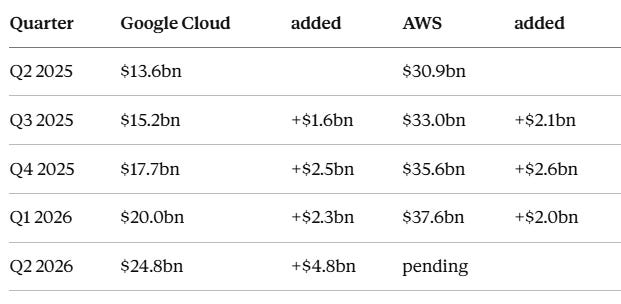
AWS is roughly twice the size of Google Cloud, with more customers and a far bigger sales force. For three straight quarters it added about the same absolute dollars.
Year on year in Q1 2026, Google Cloud added $7.7 billion. AWS added $8.3 billion.
That is not a demand driven market. That is a capacity limited one. Everyone builds as fast as they can, and roughly the same revenue falls out the bottom.
Amazon and Microsoft both report in the next week or so, and I will be watching the absolute number rather than the percentage. I expect AWS to post a large add. They have a $200 billion capex plan this year and put in close to four gigawatts of capacity during 2025.
If it disappoints badly, either the constraint is looser than I think, or Google is taking share in a way the dollars have not shown yet.
One caveat on Google’s own step up. Q2 was the first quarter they booked TPU system sales, so part of that $4.8 billion is hardware rather than cloud consumption. Management guided the bulk of that revenue to 2027, so the effect this year should be small.
The thing the market is actually worried about
Underneath the sell off is one question. Does $205 billion a year earn a return?
Fair to ask. But the evidence already points the other way, from two directions.
The disclosed number. Cloud operating income was $8.8 billion on $24.8 billion of revenue. A 35% operating margin, while growing 82%, after depreciation.
A business scaling that fast at that margin does not look like one with a returns problem.
The outside check. Liang prices to recover his hardware in ten months, which he says is roughly six times profit, and reckons there is still room to cut. That is at Chinese prices, on constrained hardware, with about 20,000 H-equivalent chips.
Google charges several times more per token. It runs on silicon it designed itself, so no Nvidia margin. It owns the data centres and the power.
So the question is not whether the returns exist. The cheapest credible operator in the world says they are substantial at a fraction of Google’s pricing.
The question is whether Google is the one company that cannot earn on this.
And the TPU revenue is not in these numbers yet. It sits in the backlog, barely touching the income statement until 2027.
Google is being marked down on a spending figure while contracted revenue has not arrived.
Why commoditisation suits Google
The market has a rule. Spend big with the best model, get rewarded. Spend big without it, get marked down.
Liang thinks that rule measures the wrong thing. On whether Anthropic’s lead over OpenAI is durable: “I don’t think so, it’s definitely episodic.”
Which is the dragon meme again, from someone with money on the outcome.
What he thinks separates the survivors is cost first, then time to market, then experience. “Cost is definitely a differentiator, perhaps the primary one.”
If he is right, being ahead on capability is a rented asset. You pay for it every cycle and lose it a few months later.
He has another line I keep returning to: “those who take more will be beaten by those taking less.” He means share of the opportunity, not margin per unit.
That is how commodity markets settle. When products converge, price falls until only the cheapest operator still makes money.
Economies of scale, basically.
One thing I want to be careful about. Liang is making a choice. Google never volunteered anything, and I will not dress this up as restraint.
What Google has is structural.
The core business is an auction. Google does not set the price of an ad. Advertisers bid against each other, and Google takes a cut of an enormous number of transactions at almost no marginal cost.
Buffett described it better than I can, explaining why the miss stung. Berkshire owned GEICO. GEICO bought the ads. They were paying “$10 a click or whatever it might have been for something that at a marginal cost to them was exactly zero.”
Huge volume. Almost no marginal cost. Price set by competition rather than by the seller.
So if intelligence commoditises, the winner is whoever can still make money at a price that ruins everybody else.
Google designs its own silicon. Owns the data centres and the network. Distribution to billions already installed.
That is not a company threatened by commoditisation. That is a company being asked to play its own game again.
The Buffett part I do not understand
For years this was his stated mistake. At the 2017 meeting: “I blew it.” He knew the founders. Berkshire owned GEICO and GEICO was buying the clicks. He did nothing with it.
Munger was harder on himself. Said they were smart enough to work it out and simply did not.
When the position appeared, people assumed it came from Weschler or Abel. Buffett settled it himself. He told CNBC he initiated it.
So this is his call. He owns the miss and the correction.
The reasoning is easy to follow. He thinks Google has the track record and the position to win. Notice that is not a claim about the best model.
What I do not understand is the price.
His whole career is buying quality on sale. American Express in 1964, when the salad oil scandal had wrecked it. Coca-Cola after the 1987 crash. Bank of America when nobody wanted a bank. Apple in 2016 at ten times earnings, when the market had written off the iPhone.
Same pattern every time. Wonderful business, temporary pessimism, cheap price.
Alphabet at $351.81 is none of those. No scandal, no crash, no pessimism. He bought directly from the company, near record levels, to fund a capital programme.
That is not distressed buying. That is paying up.
And he has said Alphabet is not among his four or five best businesses, precisely because of the capital requirements.
So he names the flaw and buys anyway, at full price.
I do not have a clean explanation. Either the opportunity is large enough that entry price matters less than it used to, or he is less price sensitive at this size than the folklore suggests. Neither is satisfying.
What I take from it is smaller. When someone with that record breaks his own rule, it is worth asking what he thinks he is looking at.
Where I could be wrong
I have talked myself into structural arguments before. They have cost me.
The denominators do not match. Liang’s payback is on inference servers. Google’s $205 billion covers training, Search serving, land, power, buildings and TPU systems sold to others. His number describes one layer, not the whole programme.
Obsolescence. A ten month payback is wonderful if the hardware lasts five years. Less so if the next generation is four times better and pricing collapses underneath the installed base. This is the risk I think about most.
And commoditisation might not happen. If capability compounds instead of converging, the leader takes the market and most of this falls apart.
I do not think that is how it plays out. But I hold it loosely.
The smaller claim I hold firmly. Cloud growth is a construction schedule, not a demand ceiling. And a 35% margin growing at 82% is not a business failing to earn on its assets.
The dragons will get redrawn. They always do.
Next, for paying subscribers
In the second half of this piece I go through IBKR’s quarter.
Another record. Accounts up 34%, client equity up 40% to $930 billion, and a pretax margin of 77% for the seventh quarter running.
I also write about my own version of Buffett’s mistake. I did buy IBKR. I just never bought enough of it, and I spent years finding reasons why.
If that is useful to you, please consider subscribing.
Disclosure: I own Interactive Brokers and Alphabet. Not a recommendation, not investment advice. Do your own work.
