
$NVO: Going against the current
Novo Nordisk raised guidance twice this year. The market still won’t pay for it.

Disclaimer: I have tried to analyse Novo Nordisk quarterly earnings and find that claude is doing a better job than me in this regards. So, i decided to share his analysis and i fact check the figure myself. Below is 100% AI output, so please read with care.
I am trying to be transparent here and towards the end, i will add some comments on my own. If you only wanted to read human output, scroll to the end! Since it is AI output, it will not be paywalled!
Novo and Lilly reported within hours of each other on 5 August. One is a turnaround priced as a melting ice cube; the other is the most expensive mega-cap in healthcare and still beating its own numbers. Here is what the two quarters actually said.
Sources: Q2 2026 investor presentations & earnings-call transcripts · prices as of 10 August 2026
Part one — the numbers
Novo Nordisk: a better quarter than the guidance implies
Novo’s second quarter is easiest to read if you hold two facts side by side. Adjusted sales grew 7% at constant exchange rates and adjusted operating profit grew 11% — and yet full-year guidance still points to a decline. That gap is the whole Novo story right now.

All of the above is adjusted: it strips out the one-off, non-cash reversal of a USD 4.2bn sales-rebate provision tied to the US 340B programme. On a non-adjusted basis, the midpoint of full-year guidance implies sales growth of 5% and operating profit growth of 12% — a very different-looking company from the one in the headlines.
Gross margin is where the cost of the fight shows up: 78.2%, down from 82.7% a year ago. About DKK 3bn of that was a one-time charge for rightsizing manufacturing capacity agreements; the rest is lower realised prices, partly offset by mix and productivity. Sales & distribution rose 13% as Novo spent behind the Wegovy pill. R&D was up just 2%. Headcount is now ~66,700, roughly 12,000 fewer people than a year ago — a 15% reduction — and the DKK 8bn transformation savings programme is running ahead of plan.
Novo Nordisk, Q2 2026 adjusted growth at constant exchange rates
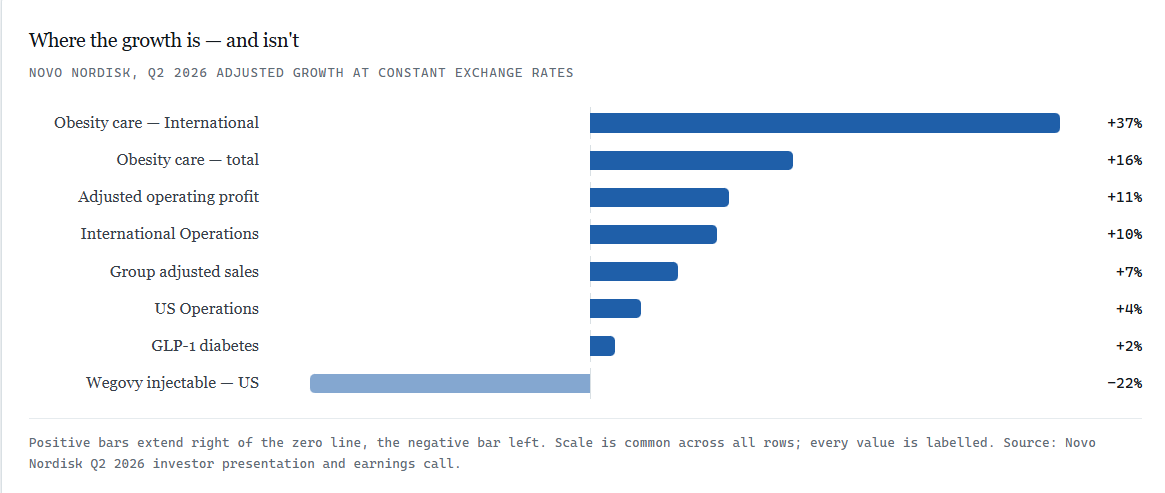
Positive bars extend right of the zero line, the negative bar left. Scale is common across all rows; every value is labelled. Source: Novo Nordisk Q2 2026 investor presentation and earnings call.
The last bar is the one that gets the attention. US injectable Wegovy fell 22% at CER even though prescriptions grew, because self-pay went from 10–15% of the mix a year ago to ~35% today at a much lower price point. Management was blunt that this is not a new pricing shock — it is the pricing environment they guided to in January, now working through the mix.
Against that, the launch metrics are genuinely strong. The Wegovy pill has passed 5 million cumulative US prescriptions in 30 weeks — the first million took 12 weeks, the most recent million took four. Weekly scripts were ~267,000 as of 17 July, roughly 90% of the US oral obesity market, with about 80% of users new to GLP-1s. Globally, ~1.5 million people are on the pill and Novo now treats nearly 5 million people for obesity, up ~70% year on year.
Guidance was raised for the second time this year: adjusted sales and operating profit growth both go to 0% to −6% CER from −4% to −12%, and free cash flow to DKK 45–55bn from DKK 36–46bn. Capex stays at around DKK 55bn.
Part two — the call
What management actually said
The 5 August call was CEO Mike Doustdar’s chance to set expectations before the September Capital Markets Day, and the tone was deliberately unheroic: “2026 continues to be a challenging year… the year is far from over, and we maintain mindful of the headwinds we are facing in the second half.”
The second half is worse on purpose
CFO Karsten Knudsen gave the cleanest bridge of the call. Take the 2% growth run rate from the first half, then subtract two things: semaglutide loss of exclusivity in Canada and Brazil, mostly back-end loaded into H2; and the absence of DKK 5bn of favourable gross-to-net effects that boosted Q3 and Q4 last year. Crucially, only one of those annualises into 2027 — the comparator effect drops out, the LOE drag does not.
The UK is the proof-of-concept for the pill outside the US
Novo made the pill broadly available in the UK in early July. Three weeks later it estimates ~300,000 patients had started, versus 48,000 in the equivalent US window. Novo’s UK obesity market share moved from ~30% before launch to ~45% after. Emil Kongshoej Larsen’s read: pent-up demand, no drug–drug interaction restrictions, and “the injection barrier is very real.” Germany launches in September.
ZEUS failed, and management refused to retreat from cardiovascular
Ziltivekimab missed its primary endpoint in 6,376 ASCVD/CKD patients — hazard ratio 0.99 (95% CI 0.88–1.11) — despite clean target engagement on IL-6 and hsCRP. Serious infections were higher on drug; all-cause mortality was neutral. R&D chief Martin Holst Lange argued the read-through is narrower than it looks: IL-6 may sit too far downstream, or the population may have been wrong. ARTEMIS (post-MI) and HERMES (HFpEF) continue, reading out in H1 2027. He also noted Novo had communicated a probability of success “around 50% or less” going in.
CagriSema is a weight-loss drug, not a diabetes drug
In the head-to-head REIMAGINE 4 trial, CagriSema hit 15.2% weight loss and 1.9pp A1c reduction against tirzepatide 15mg — non-inferior on weight, not non-inferior on A1c. That is a meaningful positioning constraint in diabetes, where glycaemic control is the scoreboard. The US obesity decision is still expected around year-end, with launch in 2027.
No transformational M&A
Asked directly about press reports of appetite for large deals, Doustdar drew the line clearly: bolt-ons that complement internal R&D, not a transformational acquisition. “I’m a person who never starts with a no. So one day maybe, but you have to be in a very different situation than Novo Nordisk is today.”
Part three
Five things that matter from here
1.The pill is expanding the market, not cannibalising the injection
Roughly 80% of Wegovy pill patients in the US are GLP-1 naive, and the UK data points the same way. If that holds through the Germany and EU rollouts, Novo’s ex-US obesity franchise is a growth story again in 2027 — which is exactly when the LOE drag is annualising against it. These two forces decide the year.
2.Price is still the binding constraint in the US
Volume grew; revenue didn’t. Self-pay mix, Medicaid coverage losses, and the most-favoured-nation agreement with the administration all pull realised price down. Novo’s answer — a subscription model for higher pill doses, with 20,000 enrolled — is deliberately surgical rather than a headline price cut. Whether that is discipline or under-reaction is the open question.
3.Medicare Bridge is real volume, and Novo is the more cautious of the two
The programme went live 1 July: ~20 million eligible seniors, $50 a month out of pocket. Both companies report 60–70% of Bridge starts are new to incretins. Lilly says roughly 80% of Bridge uptake is going to injectables — where it holds ~7 of every 10 US injectable scripts. Novo’s guidance deliberately assumes little.
4.The cost base is doing more work than the top line
Operating profit grew 11% on 7% sales growth with gross margin down 450bp. That is 12,000 fewer employees and a savings programme running ahead of schedule. It is real, and it is also finite — you cannot cut your way through a patent cliff twice.
5.The pipeline’s next act is zenagamtide, and the market is sceptical
After CagriSema’s dosing troubles and ZEUS’s failure, Novo is pushing an amylin/GLP-1 unimolecular into Phase 3 on the strength of 24% weight loss in six months in Phase 2. Management says it has added an extra titration step and applied every CagriSema learning. Investors have been told that before. The 21 September Capital Markets Day in London is where this has to be re-underwritten.
Part four
Compare and contrast: Lilly’s quarter was a different sport
Lilly reported the same morning. Revenue of $22.97bn, up 48% (46% CER); non-GAAP EPS of $8.38, up 33% — and that is after absorbing $3.03 per share of acquired IPR&D charges. Consensus was $6.58. It is the fourth consecutive quarter of a 19%+ EPS beat.
Mounjaro did $9.9bn (+91%) and Zepbound $4.9bn (+46%) — $14.9bn combined, adding $6.3bn of growth in a single quarter. That increment alone is roughly the size of Novo’s entire quarterly obesity-care business. Outside the incretins, the oncology/immunology/neuroscience key products grew 121%. Guidance went to $85–87bn for the year, a $2.5bn raise at the midpoint, implying 32% growth.
Incretin analogue market share, Q2 2026
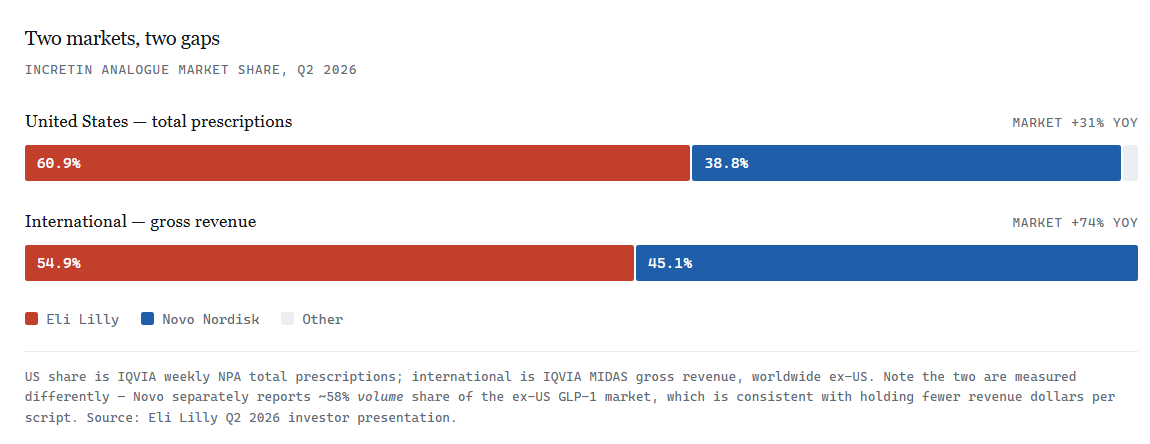
That footnote matters more than it looks. Lilly leads on revenue everywhere; Novo still leads on volume outside the US. Novo sells more units at lower prices — the profile of a company defending share on access rather than on efficacy.
Where the two genuinely differ:
Orals are the swing factor, and they are running in opposite directions. Novo’s Wegovy pill is a fast, dominant launch — 90% of the US oral market, 5 million scripts, now rolling out internationally. Lilly’s Foundayo (orforglipron) has been a slow US launch by its own admission: $98m in the quarter, of which $31m came from the UAE alone. But Lilly says the last week of July nearly doubled the prior month’s volume, prescribers went from 8,000 to 36,000, and the global rollout across 40+ markets lands in 2027. Novo has the head start; Lilly has a small molecule it can make at unlimited scale.
Efficacy ceiling. Retatrutide’s TRIUMPH results are the strongest weight-loss data yet disclosed: −28.3% at 80 weeks in obesity, −20.8% in patients with type 2 diabetes, −28.7% in the osteoarthritis study. Novo’s best comparable disclosed numbers are CagriSema at ~23% and zenagamtide’s 24% in Phase 2. Lilly plans a US submission in Q1 2027 — pending an unresolved dispute with the FDA over whether it can file as a biologic.
Breadth. Strip out the incretins and Lilly still has Ebglyss (+131%), Jaypirca (+56%), Inluriyo leading the oral SERD market, Kisunla, a PCSK9 gene-editing programme that cut LDL 62%, and a shopping spree that added psychiatry and vaccines this quarter. Novo, by contrast, has deliberately narrowed: obesity, diabetes, comorbidities, and a smaller rare-disease book.
Direction of travel on cost. Lilly’s marketing spend rose 25% and R&D 14% while margins expanded 8.9 points, because revenue grew faster. Novo expanded margin by shrinking. Both work; only one compounds.
Generic semaglutide is now a live event. First entries have appeared in early-LOE markets. Lilly’s Patrik Jonsson said tirzepatide scripts kept growing after generic semaglutide launched in India and Brazil, and that generics have hit supply constraints. Novo says the market is expanding in those countries and it has held absolute volumes. Both can be true for a while. Only one of them is losing a molecule.
Part five
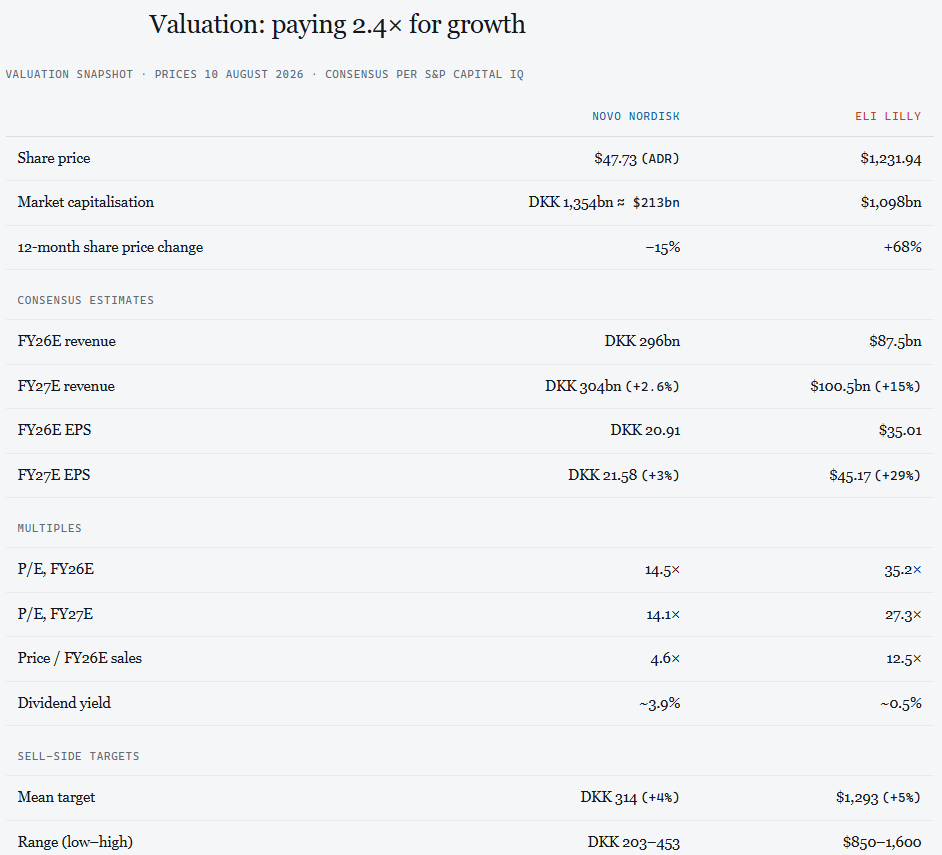
Novo’s ADR trades roughly 1:1 against the Copenhagen B share; DKK figures converted at ~6.35 DKK/USD. Novo EPS is normalised consensus in DKK; Lilly’s FY26 consensus of $35.01 sits inside its own guidance range of $35.50–36.50, which itself absorbs $3.03 of Q2 acquired IPR&D.
The arithmetic is stark. Lilly is worth 5.2× Novo’s market capitalisation on roughly 1.9× the revenue and 2.1× the earnings. Put differently, the market pays 2.4× the multiple for Lilly’s earnings — and on FY27 numbers that gap narrows to 1.9×, because Lilly is expected to grow EPS ~29% while Novo grows ~3%.
At 14× earnings with a 3.9% dividend, Novo is not priced as a slower grower. It is priced as a company whose earnings do not grow again.
Consensus makes that explicit: FY27 normalised net income of DKK 95bn is below FY26’s DKK 98bn. Novo’s answer on the call was pointedly non-committal — Knudsen would only say the GLP-1 market is growing near 40% on a moving-annual-total basis, that the starting point is the current run rate, and “don’t count us out yet.” Formal 2027 guidance comes in February.
Two things temper the cheapness. First, free cash flow is structurally suppressed: DKK 45–55bn guided against DKK 55bn of capex, so the FCF yield is only ~3.5% even though operating cash generation is far higher. That capex is building the API capacity Novo says it needs for the ex-US pill rollout — Knudsen described utilisation at the new plants as “very low,” which is either enormous latent capacity or enormous stranded cost depending on how the pill sells. Second, the sell-side mean target of DKK 314 sits just 4% above spot, with a low of 203 and a high of 453 — a standard deviation of 57 on a 303 stock. Nobody agrees on what this is worth.
Lilly’s problem is the mirror image. At 27× FY27 earnings, an enormous amount has to go right — retatrutide approved and launched, Foundayo inflecting globally, price erosion offset by volume as CVS access returns and Medicare Bridge scales. Management flagged that net price will fall as medical-exception scripts convert to formulary access. Its own mean target of $1,293 is 5% above spot. Both stocks, on the sell-side’s numbers, are fully valued. They just got there from opposite directions.
Part six
Concluding thoughts
The simplest framing: Lilly is being paid for winning; Novo is being paid for not losing. The quarter did nothing to change who is winning. Lilly took share in both the US and international incretin markets, delivered the best obesity data ever disclosed, and raised guidance while spending heavily on both promotion and acquisitions. Novo raised guidance too, but from a base that still contemplates a decline, and it did so partly on a rebate adjustment and partly on 12,000 fewer employees.
What has changed is the shape of the bear case. Six months ago, the argument against Novo was that it had lost the science and the market. The Wegovy pill undermines the second half of that: 5 million US scripts in 30 weeks, 90% of the oral market, and a UK launch that added 15 points of national obesity share in three weeks is not the behaviour of a company that cannot sell. The residual bear case is narrower and more honest — that Novo’s US pricing is deteriorating faster than its ex-US volume can compensate, that semaglutide’s patent cliff starts biting in 2027, and that the next-generation pipeline has now missed enough times that zenagamtide deserves no benefit of the doubt.
That is a real case. But at 14× earnings, a 3.9% dividend and total shareholder cash returns above DKK 60bn this year, it is also largely the case in the price. The asymmetry sits in what is not in the price: an ex-US oral launch that is tracking well ahead of the US equivalent, CagriSema’s US decision at year-end, and a Capital Markets Day on 21 September where a new CEO has to lay out what the company looks like in 2028. Any one of those landing well moves a 14× stock more than a similar surprise moves a 35× one.
For Lilly, the honest read is that execution has been close to flawless and the price reflects it. Nothing in the quarter suggests deceleration — the guidance implies a slower second half only because of one-off rebate adjustments and last year’s OUS launch bolus, which the CFO walked through explicitly. But 27× forward earnings leaves no room for a retatrutide regulatory delay, an FDA ruling against the BLA pathway, or the price erosion that management itself has flagged. The most likely disappointment for Lilly is not a bad quarter; it is a good quarter that isn’t good enough.
If you have to hold one, it depends entirely on which risk you would rather own: the risk that a great business is priced for perfection, or the risk that a merely good business is priced for decline. On today’s numbers, the second one is being compensated better.
This is analysis of publicly disclosed company materials, not investment advice. All figures are taken from the companies’ own Q2 2026 investor presentations and earnings-call transcripts dated 5 August 2026, with market data as of 10 August 2026. Novo Nordisk’s Q2 growth rates are at constant exchange rates and on an adjusted basis unless stated. Do your own work.
Human in the loop here! (100% human)
If you reach here, thanks for reading it. I know many substackers are against AI output as it is deemed as slop. However, i have a slightly different views on that but it will not be today discussion. Read the output and tell me what do you think.
I generally agree with claude analysis and as a quality investor myself, i try to find high quality businesses that compound for decades. Lily outclass novo on everything: pipeline, execution and also valuation. However, yet here i am, talking about why i owned Novo.
I think the main reason is because of loss aversion and partly also due to my value biased style. However, i find that my win rate is much higher when i owned a company that is priced for structurally declined but isn’t. I am somehow wired to perform better this way.
So, my view is that Novo is a fixable business priced as a dying business. Of course, i don’t want to overestimate myself because pharma investing is way out of my league. However, by looking at how the new management execute, i think they can overcome this challenges again.
Let me end this with Mike, the ceo quote here:
“Novo Nordisk hasn’t been around for 103 years because we’ve never had failures, but because we’ve had more successes than failures”
A small note here: Investseeker and researchpulse are some of the best x analysts that cover Novo. Do give them a follow.