

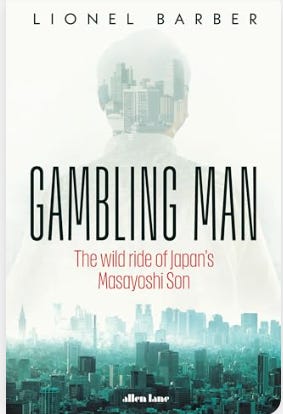
Sources: Gambling Man: The Wild Ride of Japan’s Masayoshi Son by Lionel Barber
It’s been a while since I last reviewed a book, but I recently finished one that I couldn’t wait to share with you. If you think you know SoftBank and Masayoshi Son, think again.
Lionel Barber’s The Gambling Man isn’t just another business book—it’s a front-row seat to one of the most thrilling, high-stakes stories in tech and finance over the last 35 years. Barber masterfully captures Son’s audacious bets, breakneck rises, and near-disastrous crashes, making this a must-read whether you’re a SoftBank insider or just love a good business thriller.
The rise of Softbank empire
Masayoshi Son isn’t your typical visionary CEO. He doesn’t just predict the future—he rolls the dice, bets everything, and figures it out as he goes. Born in 1957 to a Korean family in Japan, he faced discrimination as a Zainichi Korean (a term for ethnic Korean residents of Japan).
Supported by his entrepreneurial father (a pachinko kingpin, known for his willingness to go all in), he studied economics and computer science at UC Berkeley, where he was exposed to the nascent tech industry and developed his appetite for risk-taking.
Before his US studies, Masa actually met the pioneer who brought McDonald's to Japan. Inspired by his emphasis on 'computers and English,' Masa pursued his vision and be the first member to went out of Japan to pursue his study. Despite initial English struggles, he excelled at UC Berkeley, even requesting exam translations.
This drive fueled his ambition to bridge Japan's software information gap, mirroring 'PC Magazine,' and ultimately led to SoftBank. Rather than organic growth, he launched an aggressive acquisition spree, using loans (taking advantage of low interest rate environment) to buy up magazines, conferences, and any business that fit his vision. This rapid expansion, though risky, laid the groundwork for SoftBank's diverse portfolio and future dominance.
The golden goose
His first big win? In 1995, he ignored all advice and bought 35% of a struggling little company called Yahoo. By 1996, Yahoo Japan was a goldmine. By 2000, he was briefly richer than Bill Gates—only to lose $70 billion when the dot-com bubble burst. Most people would’ve quit. Masa didn’t. He doubled down. His strategy? Leverage cheap loans to fuel bigger and bolder bets.
The best one? In 2000, he poured $20 million into a barely-known Alibaba. The moment he met with Jack Ma and his business partners, he knew it was an arbitrary bet—a pure gut feeling. 'Go big or go home!' he thought. Despite Alibaba losing money at the time, Masa saw the potential. By 2014, that stake was worth a staggering $60 billion."
But for every Alibaba, there’s a WeWork—over $10 billion wasted on a hype-fueled disaster, with Masa ignoring every red flag along the way. (It is not surprising given his previous bet on ignoring others made him a fortune!)
Meeting Steve job
“The people who are crazy enough to think they can change the world are the ones who do” Steve Job
Masa's intuition and bold risk-taking were never more evident than in his pursuit of the iPhone's distribution rights in Japan. Years before its official unveiling, Masa, through a combination of astute observation and a unique rapport with Steve Jobs, deduced that Apple was developing a revolutionary phone.
During a 2005 meeting, he presented Jobs with his own rough sketch of a mobile iPod, prompting Jobs to famously retort, 'Masa, don’t give me your shitty drawing. I have my own.' This exchange, coupled with a follow-up meeting at Jobs' Palo Alto home, culminated in a 'gentleman's agreement' – a verbal promise from Jobs to grant SoftBank exclusive iPhone distribution rights in Japan.
Based on this unwritten agreement, Masa made a staggering $17 billion gamble, acquiring Vodafone Japan. This strategic move, predicated on Steve's word, proved to be a masterstroke. When the iPhone 3G, compatible with Japanese networks, launched, SoftBank's consumer business skyrocketed, validating Masa's vision and solidifying his reputation as a visionary investor who could see the future of technology.
$100billion fund
His career culminating in 2017, when he launched the Vision Fund, a $100 billion war chest backed by Saudi and UAE money, to invest in AI, robotics, and fintech. While some bets paid off—SoftBank’s ARM, acquired for $32 billion in 2016, is now worth around $160 billion.
Others, like selling Nvidia stock too early, cost him dearly. By 2020, SoftBank was drowning in $160 billion of debt, forcing him to sell Alibaba shares to stay afloat. Now, with interest rates up and tech markets shaky, some think he’s finished.
But history says never count Masa out. His story is as crazy as Elon Musk’s—dream big and focus on growth instead of profit. However, unlike Musk, Son's investments are mostly in other peoples company. Son’s not just a businessman; he sees himself as a modern-day Genghis Khan or Napoleon, building an empire his way.
He aggressively leveraged debt to fuel investments, often making billion-dollar commitments within minutes of meeting a founder. His high-risk, high-reward strategy led to extreme volatility—one moment, he was hailed as a genius investor; the next, he was scrambling to reassure shareholders.
The Lesser Known Side of Masa
Beyond the bold investments and tech-driven ventures, a lesser-known facet of Masayoshi Son reveals a leader driven by deep conviction. One defining moment came after the devastating 2011 Japan tsunami and Fukushima disaster. Deeply moved by the tragedy, he pledged $120 million of his own money and committed SoftBank to renewable energy.
When his board hesitated, he reportedly offered to step down if they didn’t back his vision. It was a rare moment where his risk-taking wasn’t about profit but about shaping Japan’s future in clean energy. This act solidified his image as a leader driven by conviction, not just capital.
Furthermore, Masa's journey has been marked by personal battles. He endured a severe bout of hepatitis, a period where he faced mortality directly in his early years. This experience, a fight for his life, profoundly shaped his perspective. His remarkable rebound, not only in health but also in business, underscores his resilience and unwavering determination.
These personal struggles, coupled with his philanthropic and vision-driven initiatives, reveal a complex and deeply human side of Masayoshi Son, a leader who dares to dream beyond the bottom line.
Whether you’re new to SoftBank or you’ve followed Son’s career for years, The Gambling Man is a wild, gripping ride. Barber’s storytelling makes it more than just finance—it’s drama, strategy, and pure adrenaline.
While Masa's high-stakes approach is certainly captivating, it's not for everyone. For those seeking a more stable path to financial freedom, I recently found a neat blog about living off dividend income. Max and his team share their plan to build passive income up to $12,000 a month for 120 months—pretty awesome idea!
A quick shoutout to Max Dividends for the great read. More exciting stuff coming your way—stay tuned!
Disclaimer: I receive no fees for writing the post. I am not affiliated or have any role with the author/blogger. Opinion is my own and this post is just for educational purpose. It is not an advice to buy or sell the stocks. Invest at your own discretion.