

At the 2000 Berkshire annual meeting, a shareholder stood up and said something that probably got applause in the room.
He told Buffett and Munger he had personally made over 100% profit in 1999 by going aggressive on tech funds. He made back every dollar he had lost on Berkshire. Then he asked, politely but pointedly: aren’t we asking too much of you men to at least put 10% of our money into the only play in town?
It was a fair question in the moment. The numbers were real. The frustration was real.
Buffett’s Answer
Buffett didn’t get defensive.
He said they would never buy anything they didn’t understand. And his definition of understanding is specific: can you reasonably assess where the business will be in ten years?
If they can’t evaluate a carbon steel company, they don’t buy it. Not because it’s a bad business. Not because it won’t go up. Just because they can’t evaluate it. Same with a chemical plant in Brazil. Same with tech.
Then he said something that stuck with me. He told the shareholder: if you have a business card, hand it out. We’ll give you a booth in the exhibitor section. Anybody who wants to invest with you is free to do so.
No ego. No argument. Just clarity about what they are and what they aren’t.
He also made a point about how he and Charlie measure themselves. Not by stock price. By the business. Berkshire’s net worth went up very slightly in 1999. The stock told a different story. But the stock doesn’t govern their ideas of value. They treat it as a private business for which a quotation occasionally exists.
If the business gets worth more at a reasonable rate, the stock will follow. Not week by week. Not year by year. But over time.
Munger’s Answer
Munger was shorter.
If you have a lot of lovely wealth in a form that makes you comfortable, and somebody down the street is making money faster in a way you don’t understand, you should not be made miserable by that process.
There are worse things in life than being left behind in possession of a lot of lovely money.
The room laughed. But he meant it.
Every Bubble He Sat Out
Buffett then listed them one by one.
Farmland tripling in the late 70s with no change in yields or commodity prices. Uranium stocks in the 50s. Conglomerates in the late 60s. Leasing companies. One after another.
He said: we know how to create a chain letter. We’ve seen it done so many times. We know the game. It just isn’t our game.
He wasn’t bitter. He wasn’t smug. He was just clear.
This Sounds Familiar
Because it is.
Replace “aggressive growth funds” with AI infrastructure plays. Replace 100% returns in 1999 with Nvidia up 800% since 2022. The shareholder letter version of this question is now on every earnings call, every podcast, every portfolio review.
Why aren’t you in AI?
And this time, most funds genuinely cannot afford to miss it.
In 1999, underperforming a tech rally was embarrassing. Today, having zero AI exposure almost guarantees you trail the benchmark. Clients notice. Capital flows out. Career risk is real. So funds pile in not because they have conviction but because sitting out costs too much professionally.
That is a completely different pressure than what Buffett and Munger faced in that room.
But Not All AI Is Created Equal
If you had to be somewhere, the Mag 7 seems like a good start and it is also where most of the money flow into.
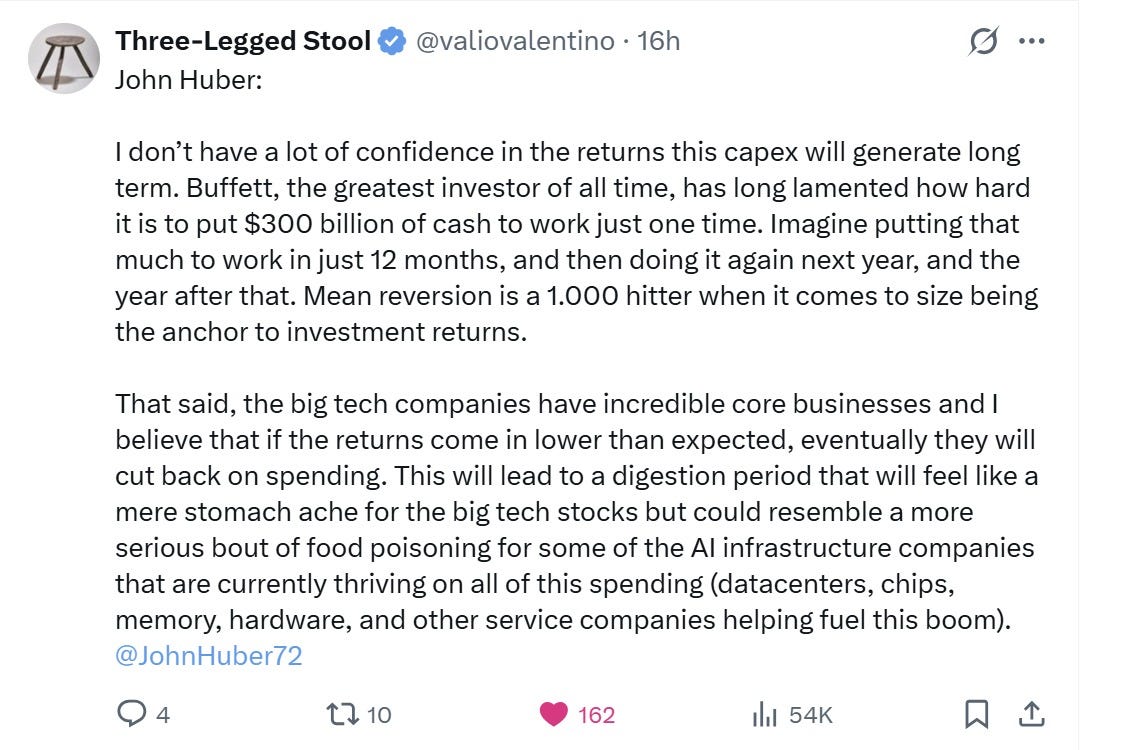
These are not the dot-com basket of 2000. Real businesses. Real moats. Enormous free cash flow. John Huber makes the point well: if AI capex returns come in below expectations, the big tech companies will simply cut spending. They have the flexibility. They absorb it and move on.
For them, it is a stomach ache.
For the companies thriving on all that capex today: datacenters, chips, memory, hardware, a pullback looks more like food poisoning. They are entirely dependent on spend that could slow. That is the risk Huber flags.
And then there is software. That one is mine.
AI is actively replacing software. Not disrupting it at the edges. Replacing it at the core. The question is no longer whether the category gets compressed. It is which companies survive. And picking the last man standing in a field being restructured in real time is one of the hardest things you can do as an investor. Tricky is an understatement.
The One Edge That Never Goes Out of Style
Buffett works because he is ruthlessly honest about the edges of his own competence. He doesn’t sit out tech because tech is bad. He sits it out because he cannot underwrite it with confidence.
You can whack him for the last 20 years performance. Plenty of young fund managers have put up numbers that make Berkshire look pedestrian. The AI trade alone minted a generation of investors who think they have cracked the code.
Maybe they have. We will find out.
But what made Berkshire special was never the best year. It was the absence of a catastrophic one. Decades of compounding, uninterrupted. No blowups. No style drift. No chasing the game of the decade just because everyone else was playing it.
Longevity is the edge. And staying out of things that can hurt you is what protects it.
That is harder than it sounds. The pressure to participate is real. The career risk of sitting out is real. And sometimes what you call discipline is just stubbornness in disguise.
But Buffett’s record exists because he kept asking the same question for 60 years: do I actually understand this? And when the answer was no, he walked away. Every single time.
That is not a limitation. That is the whole game.


